In this article
- The lifecycle
- Stage by stage
- 1. Discovery
- 2. First contact
- 3. Qualification
- 4. Consideration
- 5. Purchase
- 6. Delivery
- 7. Feedback
- 8. Retention
- 9. Advocacy
- 10. Win-back
- Find your own leak
- What to automate across the lifecycle
- One contact record through all ten
- The numbers that summarise the whole thing
- Where to start
- Frequently asked questions
Every article we have written about messaging covers one stage. This one puts them in order, so you can see where your own business leaks.
Most businesses are strong at two or three stages and weak at the rest. The weak ones are usually the invisible ones, where nobody complains and the customer simply does not return.
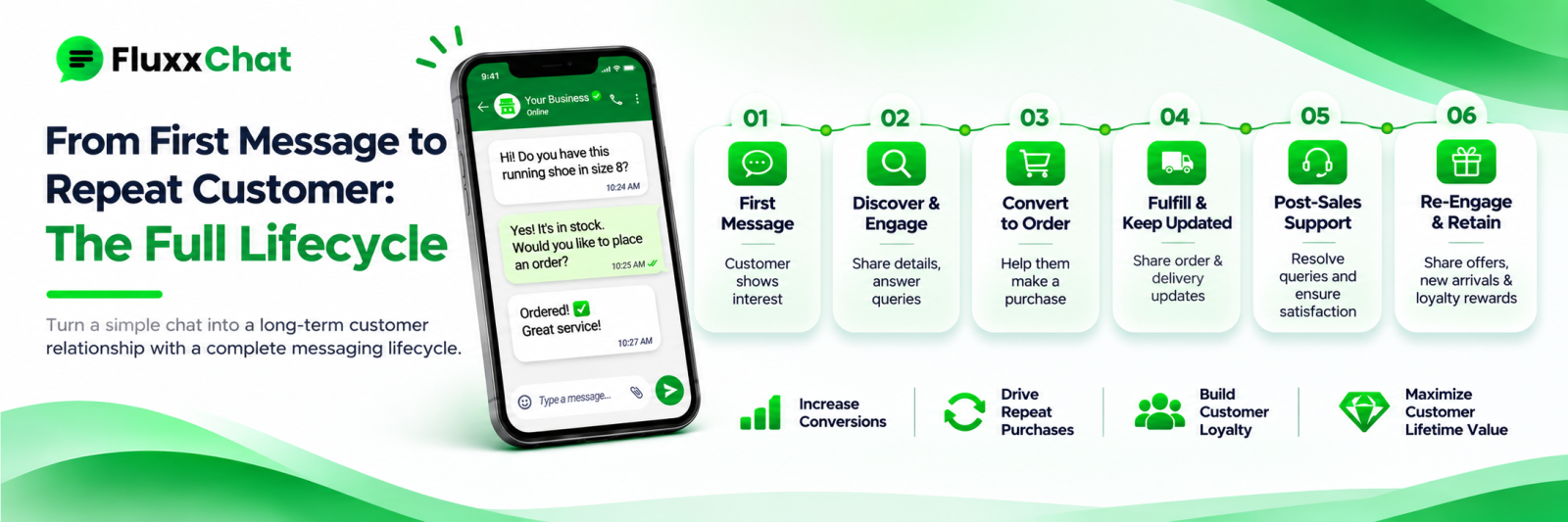
The lifecycle
1. Discovery → they find you
2. First contact → they message
3. Qualification → you understand what they need
4. Consideration → they decide
5. Purchase → money changes hands
6. Delivery → you deliver
7. Feedback → you learn
8. Retention → they come back
9. Advocacy → they bring others
10. Win-back → they lapse, you return
Ten stages. Count how many your business handles deliberately.
Stage by stage
1. Discovery
They see a reel, a post, an ad, a QR code, a friend’s recommendation.
What to do: make every entry point lead to a conversation. Comment-to-DM on posts, WhatsApp links everywhere, QR codes in the shop.
Measure: enquiries by source.
See our Instagram lead generation guide.
2. First contact
The message arrives. This is where most businesses lose people and never know.
What to do: automated reply in seconds, containing real information — price range, availability, options — not “how can I help?”. Human within minutes.
Measure: first response time.
See our auto reply guide.
3. Qualification
One or two questions that tell you what to offer.
What to do: ask the question that changes your answer. Size, date, city, budget range. Store it against the contact.
Measure: share of enquiries where you captured the requirement.
4. Consideration
They are comparing. This is where follow-up matters.
What to do: answer the real objection, give a reason to choose now, follow up once at 24 hours and once more later. Do not pressure.
Measure: enquiries that went quiet, and your recovery rate.
See our follow-up guide.
5. Purchase
What to do: clear order summary, payment link or UPI, written confirmation of what was paid and what is coming.
Measure: enquiry-to-customer rate.
See our payments in chat guide.
6. Delivery
What to do: proactive status updates. Tell them about delays before they ask.
Measure: “where is my order” messages per 100 orders.
See our order status guide.
7. Feedback
What to do: one question, a few days after delivery. Respond to every low score with a human, within 24 hours.
Measure: response rate, score trend, detractors contacted.
See our chat surveys guide.
8. Retention
The stage most businesses skip entirely.
What to do: rebooking and reorder reminders at the natural interval, service reminders, milestone messages, a reason to return.
Measure: repeat purchase rate, average purchases per customer per year.
See our milestone messaging guide.
9. Advocacy
What to do: ask happy customers for a review and a referral, at the moment of satisfaction. Reshare their content with permission.
Measure: referrals, reviews, UGC received.
See our referral guide and UGC guide.
10. Win-back
What to do: define lapsed for your business, detect it automatically, ask why before you offer anything.
Measure: lapsed customers detected, return rate.
See our win-back guide.
Find your own leak
Score each stage honestly: done well, done inconsistently, not done at all.
Stage | Common state in small businesses |
Discovery | Usually some effort |
First contact | Often slow outside working hours |
Qualification | Rarely recorded |
Consideration | Follow-up usually once, or never |
Purchase | Usually fine |
Delivery | Updates often missing |
Feedback | Rarely collected |
Retention | Almost never deliberate |
Advocacy | Rarely asked for |
Win-back | Almost never |
The pattern is consistent: businesses invest in getting customers and almost nothing in keeping them. Stages 7 to 10 cost very little and are where most of the available revenue sits.
What to automate across the lifecycle
Stage | Automate | Human |
1 Discovery | Comment-to-DM, entry points | Content |
2 First contact | Instant reply with information | Follow-up within minutes |
3 Qualification | Standard questions | Anything unusual |
4 Consideration | Reminder to the salesperson | The conversation |
5 Purchase | Payment link, confirmation | Negotiation |
6 Delivery | Status updates | Problems |
7 Feedback | The request | Every negative response |
8 Retention | Reminders at intervals | Personal contact with top customers |
9 Advocacy | The ask, after a good score | Thanking real advocates |
10 Win-back | Detection and first message | High-value customers |
Automation handles the timing and the repetition. People handle the judgement and the value.
One contact record through all ten
None of this works if the customer is three records across two channels. One record, carrying source, requirement, purchase history, preferences, consent and conversation history, is what lets stage 8 know what happened at stage 3.
See our customer database guide and omnichannel guide.
The numbers that summarise the whole thing
Metric | What it covers |
First response time | Stages 2–3 |
Enquiry-to-customer rate | Stages 2–5 |
“Where is my order” rate | Stage 6 |
Satisfaction score | Stage 7 |
Repeat purchase rate | Stage 8 |
Referrals per customer | Stage 9 |
Lapsed rate and win-back rate | Stage 10 |
Revenue per customer per year | All of it |
If you track two, track repeat purchase rate and revenue per customer per year. They measure whether the whole lifecycle works, not just the parts that are easy to see.
Where to start
Pick the one stage you scored lowest and fix only that for a month. Most businesses find it is stage 7 or 8, and both are cheap to fix.
Then measure the one number attached to it, and do the next stage.
Frequently asked questions
Where do most businesses lose customers? Between delivery and the next purchase. Nothing happens, so nothing brings them back.
Do we need all ten stages? Every business has all ten whether it manages them or not. The choice is whether they happen deliberately.
What is the cheapest improvement? Asking for feedback and acting on it, followed by a reorder or rebooking reminder at the right interval.
Ready to automate WhatsApp and Instagram?
Start with FluxxChat: campaigns, chatbot and a shared inbox for your team.
Get started free