In this article
Almost every business is better at one of these than the other. Sales-led businesses answer enquiries in seconds and go quiet after payment. Service-led businesses look after existing customers and let new enquiries sit for hours.
They are different jobs with different measures, and treating them as one inbox is why one of them always suffers.
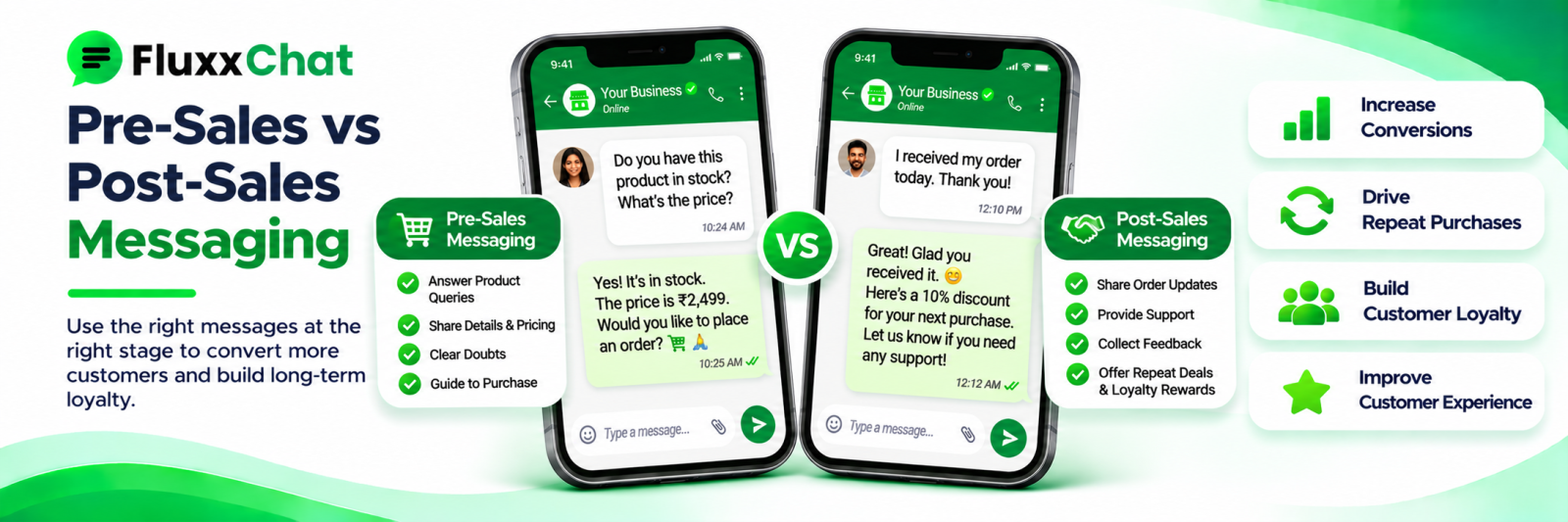
The two jobs
| Pre-sales | Post-sales |
Goal | Convert an enquiry | Deliver, retain, re-sell |
Who is messaging | A stranger | A customer who has paid |
Urgency | Extreme; they are comparing | High for problems, lower otherwise |
Tone | Persuasive, helpful | Reassuring, accountable |
Key metric | Conversion rate | Satisfaction and repeat rate |
What loses you money | Slow replies | Unresolved problems |
Automation role | Instant answers, qualification | Status updates, reminders |
Skills needed | Selling, product knowledge | Patience, problem-solving, authority to fix |
Cost of failure | A lost sale | A lost customer and a public complaint |
That last row matters. A lost enquiry is invisible. A mishandled customer tells people.
Pre-sales: speed decides it
The buyer has messaged three businesses. The first useful reply usually wins.
• Automated reply within seconds, containing real information
• A human within minutes during working hours
• One qualifying question, not five
• Price range given, not withheld. See our price questions guide
• A clear next step
• Follow-up if they go quiet. See our follow-up guide
The pre-sales inbox should never have an unanswered message older than an hour during business hours. That is the whole discipline.
Post-sales: reliability decides it
The customer has paid. Now they want to know what is happening and to be taken seriously if something is wrong.
• Proactive status updates, before they ask. See our order status guide
• Fast response to problems, with authority to fix them
• Honest communication about delays
• Delivery and completion confirmed
• Feedback requested
• Rebooking or reorder at the right interval
Post-sales fails quietly. The customer does not complain; they just do not come back. Which is why it needs measurement, not just responsiveness.
Route them separately
The practical fix: identify which is which at the point of arrival.
• A customer with an order in progress → post-sales queue
• A new contact with no order history → pre-sales queue
• An order number mentioned → post-sales
• Keyword route: “1 — new enquiry, 2 — about my order”
Then assign them to different people, or at least to different queues with different targets.
A salesperson handling a complaint mid-negotiation handles both badly. A support person handling a hot enquiry usually under-sells it.
Different targets
Measure | Pre-sales | Post-sales |
First response | Under 5 minutes | Under 30 minutes |
Resolution | Not applicable | Within SLA by severity |
Follow-up | Until decided | Until resolved |
Escalation trigger | Deal size | Complaint severity |
Review | Conversion rate weekly | Satisfaction and repeat rate monthly |
The handover between them
The moment of payment is where businesses drop customers.
What should happen automatically:
1. Order confirmed, with a summary
2. Contact moves to the post-sales queue
3. The salesperson’s promises are recorded and visible to whoever delivers
4. Expected timeline communicated
5. Named contact for questions
Promises made during pre-sales must be visible post-sales. “He said you’d include the extra set” is a conversation that only goes well if someone wrote it down. A shared inbox with full history is how that happens. See our shared inbox guide.
Automation differs
Pre-sales automation answers questions: price, availability, timing, delivery, booking. Its job is to be instantly useful to someone who may not become a customer.
Post-sales automation reports status: confirmed, dispatched, delivered, due for service, renewal coming. Its job is to tell the customer things before they ask.
The messages that work in one read badly in the other. A cheerful sales greeting to someone chasing a delayed order is irritating.
Where each business tends to fail
Retail and D2C: good pre-sales, weak post-sales. Orders dispatched with no updates, no feedback request, no reorder prompt.
Service and B2B: good post-sales with existing clients, slow pre-sales. New enquiries wait while the team serves current work.
Clinics and appointment businesses: good at the appointment, weak at follow-up and rebooking.
Restaurants: good at the moment of service, almost nothing afterwards.
Honestly assess which you are. The fix is usually assigning an owner to the weaker side, not working harder on the stronger one.
Measure them separately
If you report one combined “response time”, you will hide a problem in one half.
Pre-sales | Post-sales |
Enquiries received | Orders in progress |
First response time | Problem response time |
Enquiry-to-customer rate | Issue resolution time |
Lost reasons | Satisfaction score |
Follow-ups made | Repeat purchase rate |
Revenue from new customers | Revenue from existing customers |
That last pair is the strategic view. A business where almost all revenue comes from new customers is paying for growth it keeps losing.
Frequently asked questions
Can one person do both in a small business? Yes, but with different modes and different targets. Check the pre-sales queue first thing in the day; schedule post-sales updates as a routine.
Which matters more? Pre-sales grows the business; post-sales keeps it. Businesses that neglect post-sales pay to acquire the same customer twice.
How do we stop enquiries sitting while we serve customers? Automate the first reply, and give one person explicit responsibility for the enquiry queue each day.
Ready to automate WhatsApp and Instagram?
Start with FluxxChat: campaigns, chatbot and a shared inbox for your team.
Get started free