In this article
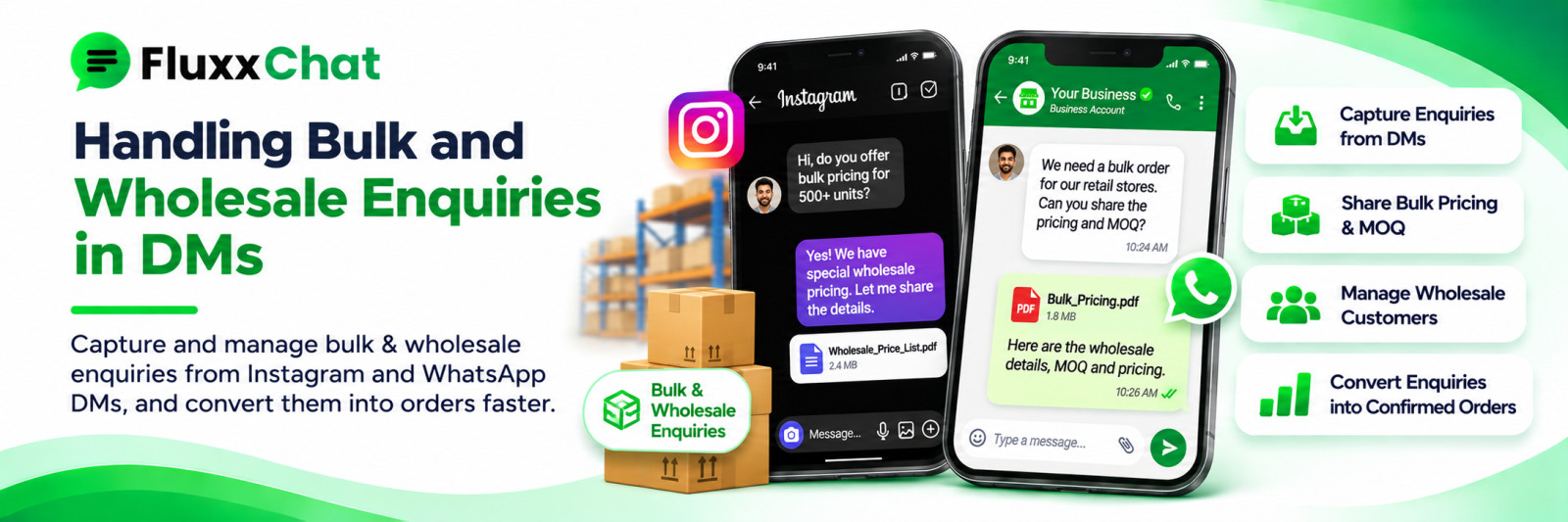
A retail Instagram account gets a DM: “Do you supply in bulk? I need 500 pieces.” That message is worth a hundred retail enquiries, and most businesses answer it with the same automated retail reply that everyone else gets.
Wholesale enquiries need different handling, different pricing and usually a different person.
Identify them early
Add keyword rules so bulk enquiries are flagged the moment they arrive:
• bulk, wholesale, quantity, pieces, dozen, carton, container
• distributor, dealer, reseller, retailer, stockist
• MOQ, rate list, price list, quotation
• Tamil and Tanglish equivalents: mottham, wholesale rate, bulk ah
Route these to a named person, not the general queue. A wholesale enquiry answered in two days has usually gone elsewhere.
Qualify before quoting
Four questions decide whether this is real:
1. Quantity — what are we actually talking about?
2. Purpose — reselling, own use, gifting, corporate?
3. Location — delivery feasibility and freight cost
4. Timeline — immediate, or planning?
Thanks for your interest! To give you accurate wholesale rates, could you tell me: • Approximate quantity • Is this for resale or your own use? • Your city • When you need it
Ask all four in one message. Asking one at a time over four exchanges loses serious buyers.
Add a fifth for regular supply: “Is this a one-time order or ongoing?” Ongoing supply is worth different terms.
Set MOQ and pricing rules clearly
Decide and publish:
Tier | Quantity | Discount off retail |
Small bulk | [X]–[Y] pieces | [a]% |
Wholesale | [Y]–[Z] pieces | [b]% |
Distributor | Above [Z] | [c]% + territory terms |
And state:
• Minimum order quantity
• Whether mixed items count toward MOQ
• Payment terms: advance, partial, credit
• Delivery terms: ex-works, freight extra, freight included
• Lead time for bulk production
• Customisation possible and its minimum
A rate card that staff can send immediately is far better than “let me check and get back to you”.
Protect your retail pricing
The risk with wholesale is a reseller undercutting your own retail prices online.
Options:
• Separate wholesale catalogue, not publicly visible
• Minimum resale price expectations, where lawful; take advice, as resale price maintenance has competition law implications in some contexts
• Territory or channel restrictions in your dealer agreement
• Different product lines or packaging for wholesale
Confirm what restrictions you may lawfully impose with a legal adviser. This article is not legal advice.
Credit checks
Bulk orders on credit are where businesses lose real money.
For a new wholesale buyer:
• Business name, GSTIN, address
• Advance payment on the first order, always
• References from other suppliers, for larger orders
• Credit only after a track record of [X] orders
• Credit limit set and enforced
• Written terms, acknowledged
A large first order from an unknown buyer requesting credit is the classic pattern of a bad debt. Advance on the first order is not insulting; it is normal.
See our receivables guide.
Samples
• A clear sample policy: free, charged, or charged and adjusted against the first order
• Sample cost recovered on orders above [X]
• Limit on free samples per enquirer
• Track who received samples and whether they ordered
Charging for samples and adjusting against the order filters out people collecting free products. Serious buyers do not object.
Move it out of the DM
Instagram DM is where the enquiry arrives; it is not where a ₹5 lakh order should be negotiated.
1. Qualify in the DM
2. Move to WhatsApp with the buyer’s business number
3. Send the catalogue and rate card
4. Formal quotation by email, with terms
5. Confirm by purchase order or written confirmation
See our B2B messaging guide and WhatsApp vs email guide.
Keep wholesale separate in your records
• Tag the contact as wholesale, with tier
• Separate pricing applied automatically
• Order history per account
• Payment behaviour recorded
• Territory, if you assign one
• A separate view of wholesale pipeline and revenue
Without this, wholesale customers receive your retail offers and retail customers occasionally receive wholesale rates, both of which cause problems.
Watch for the enquiries that are not real
• Vague large quantities with no specifics
• Immediate requests for credit on a first order
• Pressure to ship before payment clears
• A delivery address that changes at the last moment
• Requests for your supplier details rather than your products
• Enquiries that are really competitors checking your rates
Qualify properly, insist on advance for first orders, and verify the business exists.
Measure
Metric | Why |
Bulk enquiries per month | Channel potential |
Response time to bulk enquiries | Usually the deciding factor |
Enquiry to first order conversion | Qualification and pricing |
Average wholesale order value | Economics |
Repeat order rate from wholesale accounts | The real value |
Wholesale as % of revenue | Business mix |
Bad debt from wholesale | Credit discipline |
Repeat order rate is what makes wholesale worthwhile. A one-time bulk buyer is a transaction; an account ordering monthly is a business.
Frequently asked questions
Should we publish wholesale prices? Publish tiers and MOQ, not full rate cards. It filters enquiries without exposing your margin structure.
Can one team handle retail and wholesale? At low volume, yes, with separate routing. As wholesale grows it needs its own owner.
Should we give credit to new wholesale buyers? Not on a first order. Build a payment track record first.
Ready to automate WhatsApp and Instagram?
Start with FluxxChat: campaigns, chatbot and a shared inbox for your team.
Get started free