In this article
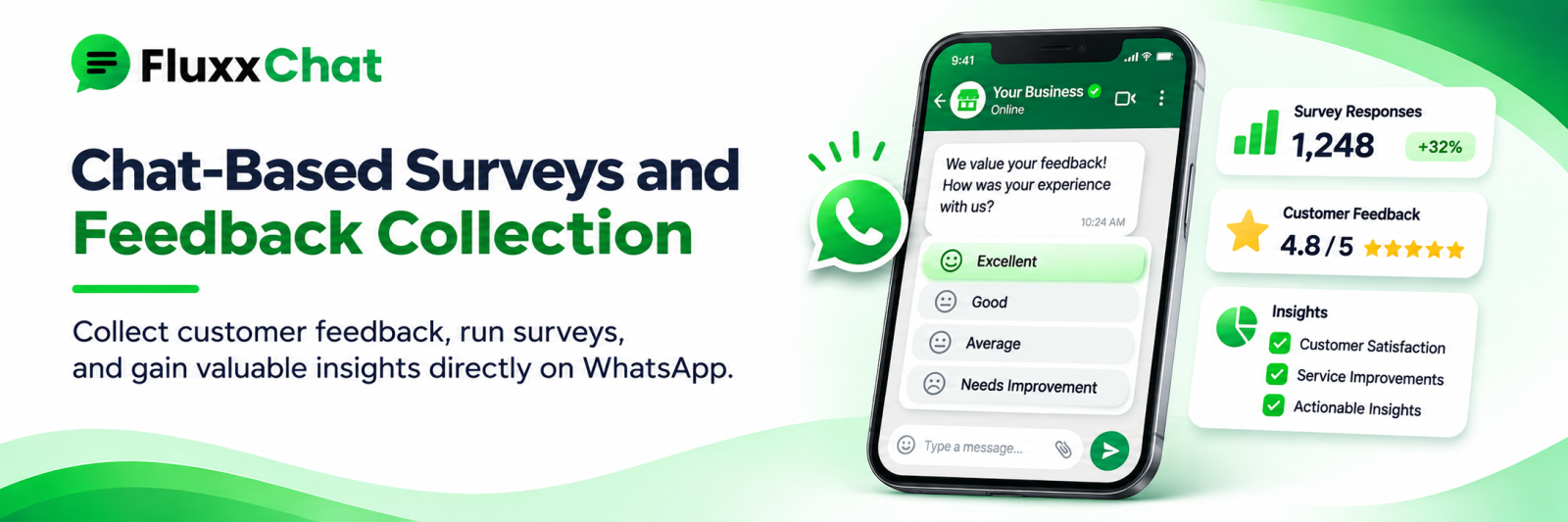
A feedback form emailed after a purchase gets a very low response rate. The same question asked as a WhatsApp message gets many times more replies, because the customer taps one key instead of opening a browser.
The limitation is the reverse: you cannot ask much. One or two questions, and you are done.
Why chat works better
| Email form | Chat survey |
Effort for the customer | Open, load, scroll, submit | Type one number |
Response rate | Low | Substantially higher |
Length possible | Long | One or two questions |
Follow-up | Separate email | Continue the same conversation |
Timing | Whenever opened | Immediate |
Qualitative replies | Rare | Common, because replying is easy |
That last row is underrated. In chat, people answer “why?” in their own words far more often than in a form, and those sentences are the useful part.
Keep it to one question
The first question should be the one that matters:
How was your experience today? Reply with a number: 5 — Excellent 4 — Good 3 — Okay 2 — Poor 1 — Very poor
Then one follow-up, conditional on the answer:
• 4 or 5: “Glad to hear it! Would you mind leaving us a Google review? [link]”
• 3: “Thanks — what would have made it better?”
• 1 or 2: “Sorry to hear that. What went wrong? I’ll look into it personally.”
Three questions is the maximum anyone should face in a chat survey.
When to ask
Business | Timing |
Retail | Same day, after purchase |
Restaurant | That evening |
Service centre | After delivery of the vehicle or appliance |
Clinic | After the appointment |
Ecommerce | A few days after delivery, once used |
Hotel | At checkout |
Project work | At completion, then periodically |
Subscription | Quarterly, and after any support interaction |
Ask once per interaction. Asking the same customer every week destroys both response rate and goodwill.
Do not survey everyone, every time
• Suppress customers with an open complaint
• Suppress anyone surveyed in the last [30] days
• Suppress customers who opted out
• Sample rather than census if your volume is high
A customer who gets a cheerful “how was your experience?” while waiting for a refund will tell you, loudly and publicly.
Handling the answers
This is the part that matters, and the part usually skipped.
Score | Action | Timeline |
1–2 | A real person responds, understands, fixes | Same day |
3 | Ask what would improve it; respond | 24 hours |
4 | Thank; ask what would have made it a 5 | Automated is fine |
5 | Thank; invite a review or referral | Automated is fine |
Set a rule: every 1 and 2 gets a human response within 24 hours, with a named owner. Measure how many actually did.
A low score responded to well often produces a more loyal customer than a high score ignored.
Reviews: ask the happy ones
The sequence that works:
1. Ask for feedback privately
2. Promoters are invited to leave a public review, with a direct link
3. Detractors go to your team instead
This is legitimate: you are asking satisfied customers at the right moment. What is not legitimate is paying for reviews, writing them yourself, or offering rewards conditional on a positive review. Those breach platform policies and advertising rules.
See our review response guide.
Other things worth asking in chat
Short, single-question surveys work for more than satisfaction:
• “Which of these should we stock next? Reply A, B or C”
• “Would you prefer morning or evening slots?”
• “What stopped you from ordering this time?” — to enquirers who did not buy
• “What should we add to the menu?”
• “How did you hear about us?”
See our using chat data guide.
Rules and cost
Business-initiated WhatsApp messages need opt-in and approved templates, and category rules affect cost. A post-purchase feedback request is generally treated differently from a marketing message, but confirm current classification and pricing before running these at volume.
See our templates guide.
Watch for bias
• People with extreme experiences reply most
• Staff asking in person get inflated scores
• Low response volumes make month-to-month swings meaningless
• Customers who left silently never respond at all
Treat the trend and the themes as the signal, not a single month’s average.
Close the loop publicly
When feedback leads to a change, say so:
“You told us the evening wait was too long. We’ve added staff from 6 to 9 pm. Thank you for telling us.”
This single habit does more for response rates than any incentive, because customers learn that answering changes something.
Measure
Metric | Why |
Response rate | Whether the survey works |
Average score, trend | Direction |
Detractors contacted within 24 hours | Process discipline |
Themes by frequency | What to fix |
Review conversion from promoters | Public proof generated |
Recovery rate: detractors who buy again | The real value |
Frequently asked questions
How many questions can we ask in chat? One, plus one conditional follow-up. Three is the maximum.
Should we incentivise responses? Rarely, and never conditional on a positive score. A thank-you works; a reward for a 5-star rating is a policy breach.
What if scores are always high? Check whether staff are asking selectively. Also ask the “what would have made it a 5?” question, which surfaces more than the score does.
Ready to automate WhatsApp and Instagram?
Start with FluxxChat: campaigns, chatbot and a shared inbox for your team.
Get started free