In this article
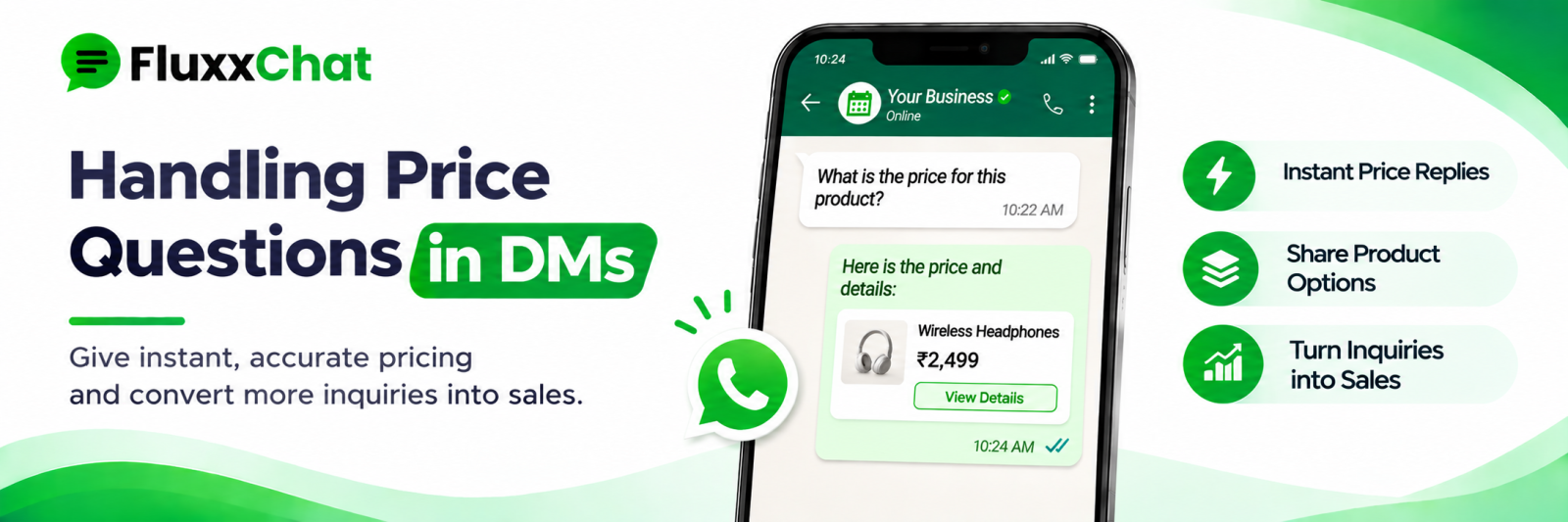
“Price?” is the most common message any consumer business receives, and the most commonly mishandled. The usual answers — “DM”, “inbox please”, or a flat number with no context — both lose sales, for opposite reasons.
How you answer this one message decides a large share of your conversion rate.
Why “DM for price” fails
Businesses hide prices believing it forces a conversation. It does produce more DMs. It produces fewer customers.
What hiding prices does | Effect |
More enquiries | From people who will leave when they hear the price |
More staff time | Answering the same question all day |
Loses serious buyers | Many will not ask; they move to a competitor who published it |
Signals something to hide | Especially in categories where overcharging is expected |
No search traffic | “Price” searches go to whoever published |
Showing price filters out mismatched enquiries and raises the quality of the rest. Your enquiry count falls and your conversion rate rises, which is the trade you want.
Answer with a range plus a question
The pattern that works, whatever the business:
[Product] starts at ₹[X] and goes up to ₹[Y] depending on [the variable]. Which one are you looking at? I’ll send exact pricing and availability.
Three things happen: they get a real answer, they learn what drives the price, and they are invited to continue. A bare number ends the conversation either way — too high, they leave; acceptable, they say “ok” and vanish.
Adapt by business type
Retail with fixed prices
This one is ₹2,499, available in blue, green and maroon. Which colour would you like? Delivery to [city] is ₹[X], usually [Y] days.
Services with variables
Our wedding photography starts at ₹[X] for a single day and goes to ₹[Y] for a full package with video and album. How many days are you planning, and which date?
Custom or project work
It depends on [the two or three real variables]. Typical projects in your range run between ₹[X] and ₹[Y]. Can you tell me [one specific question]? I’ll give you an exact figure today.
High-value B2B
Pricing depends on quantity and specification. For [typical quantity] it is usually around ₹[X] per unit. What quantity and specification are you looking at? I’ll send a formal quotation.
Never say “it depends” without giving a range. It reads as evasion.
Automate the first answer
A price question should be answered in seconds, at any hour. Build it as a keyword rule, with all the variants your customers actually type — English, Tamil and Tanglish. See our multilingual messaging guide.
The automated reply gives the range and asks the qualifying question. A human takes over from there. This alone removes a large share of your inbox load while improving response time.
Handling “can you reduce?”
Discount requests are normal in most Indian categories. Decide your policy in advance so every agent answers the same way.
If you do not discount:
We keep our prices as tight as we can, so there isn’t much room 🙂 What I can do is [free delivery / an add-on / priority slot]. Would that work?
If you have limited room:
For [quantity/package] I can do ₹[X]. That’s the best I can offer on this one.
If they push repeatedly:
I understand, but ₹[X] is genuinely where we are on this. I’d rather be straight with you than keep negotiating 🙂
Rules that keep this sane:
• Agree the discount limit per agent in writing
• Give value instead of price where possible; it costs less and does not reset expectations
• Never discount on the first ask, or customers learn to always ask
• Be consistent; customers compare notes
• Once you have said a final price, hold it
When they go quiet after the price
Very common, and usually recoverable. Do not take silence as rejection.
Still thinking about it? Happy to answer anything — or if the budget is the issue, I can show you something in a lower range 😊
Offering a cheaper option is more effective than discounting the same one. See our follow-up guide.
Keep price information in one place
With several people answering, the main risk is two staff quoting different numbers to the same customer.
• One price list, maintained by one person
• Prices in keyword rules, not in agents’ memory
• Never let AI generate prices; keep them in fixed rules. See our keyword vs AI guide
• Update everywhere at once: catalogue, website, auto-replies, canned responses
• Tell the team the day a price changes
An outdated price in an auto-reply is a commitment you may have to honour.
Publish prices where they can be searched
Beyond the inbox:
• Price ranges on your website service pages
• Starting prices in your Instagram bio or highlights
• Price in the catalogue
• A pricing page that can rank for “[service] price in [city]”
Those searches exist for every category, and they are the highest-intent searches you will ever receive.
Measure
Metric | Why |
Price enquiries per week | Volume |
Replies after the price is given | Whether your answer invites continuation |
Price enquiry to customer rate | The real conversion number |
Discount given, average | Margin discipline |
Lost reasons recorded as “price” | Whether you are actually mispriced |
Conversion before and after publishing prices | The test worth running |
If a large share of losses are recorded as price, the issue may be positioning rather than the number: you may be explaining value badly rather than charging too much.
Frequently asked questions
Should we ever hide prices? Rarely. Genuinely bespoke work can quote after a scoping conversation, but give a range even then.
What if competitors are cheaper? Say what the difference buys. “Theirs is ₹X; ours is ₹Y because [specific reason].” Never criticise them.
Does publishing prices reduce enquiries? Usually yes, and it increases customers. Count conversions, not messages.
Ready to automate WhatsApp and Instagram?
Start with FluxxChat: campaigns, chatbot and a shared inbox for your team.
Get started free