In this article
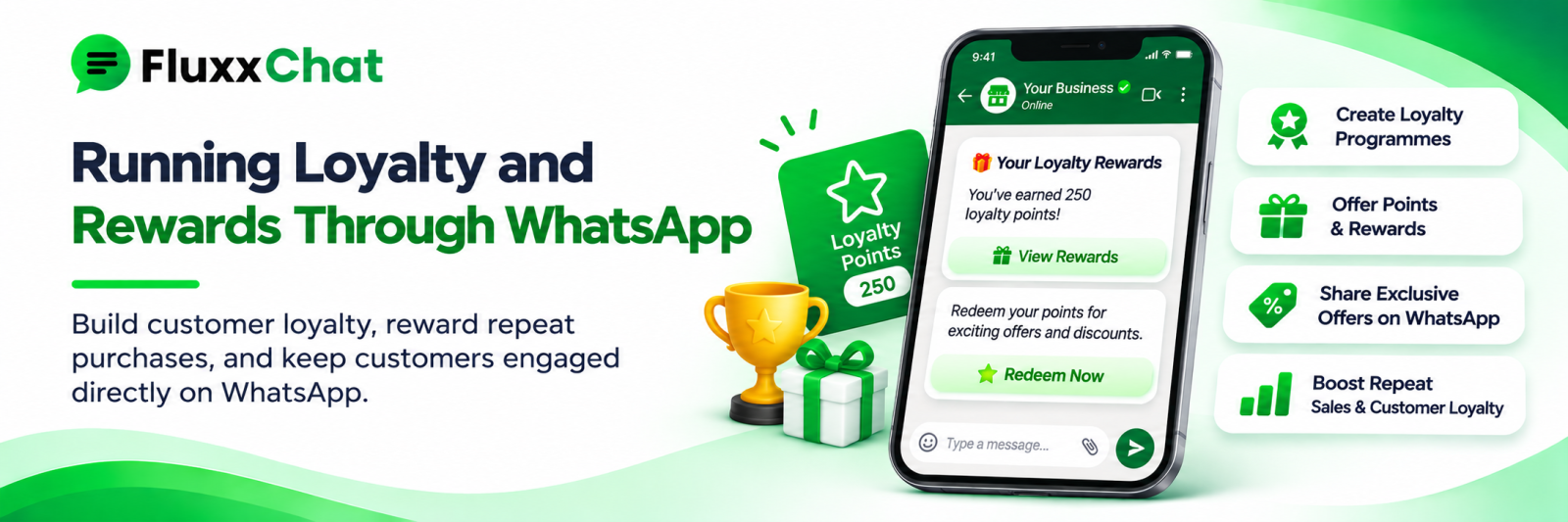
Loyalty apps fail for small businesses because customers will not install them. Punch cards fail because they get lost. A loyalty programme run through WhatsApp avoids both: the customer already has it, and the balance lives with you.
Why chat-based loyalty works
• Nothing to install
• Enrolment takes one message
• Balance available on demand, at any hour
• Rewards communicated where the customer will read them
• The same channel handles reminders, offers and support
• Works for customers who will never download an app
The trade-off: it needs staff to record transactions, which is where most programmes break down.
Programme types
Type | How it works | Suits |
Visit-based | Every Nth visit is free or discounted | Salons, cafes, car wash, tiffin |
Points | Earn per rupee, redeem against purchases | Retail, pharmacy, grocery |
Cashback wallet | A share of each bill returns as balance | Restaurants, retail |
Tiers | Silver, gold, platinum with growing benefits | Higher-value services |
Spend milestone | Reward at cumulative spend thresholds | Jewellery, electronics |
Keep the rule explainable in one sentence at the counter. “Every 10th haircut free” is understood instantly; “earn 2.5 points per ₹100, redeemable at 1 point = ₹0.40 on bills above ₹500” is not.
Enrolment in chat
Hi! Join our rewards programme — you’ll earn [reward] on every visit. Reply JOIN with your name to enrol.
Then confirm:
You’re in, [Name] ✅ You’ll earn 1 point for every ₹100 you spend. 100 points = ₹[X] off. Reply BALANCE anytime to check your points.
Enrolment should take under thirty seconds at the counter, with staff scanning a QR or the customer sending one message.
Recording transactions
This is the operational bottleneck. Options:
1. Billing system integration. Points calculated automatically from the bill. Best, requires integration. See our API integration guide.
2. Staff entry. A staff member enters the phone number and amount at billing. Workable, needs discipline.
3. Customer-initiated. Customer sends a photo of the bill; you credit it. Low effort for you, high effort for them, and open to abuse.
4. QR at the counter. Customer scans and the transaction is logged against them.
Integration is the only one that survives a busy counter indefinitely. If you cannot integrate, expect to lose some transactions and accept that.
Balance and redemption
Balance on demand:
Reply BALANCE → “You have 340 points, worth ₹[X]. 160 more points for your next reward 🎉”
The “X more to your next reward” line is what drives the next visit. Always include it.
Redemption:
• Customer asks to redeem, or staff checks at billing
• Balance verified
• Reward applied to the bill
• Points deducted
• Confirmation message sent
Redemption must be fast at the counter. If checking a balance takes a minute during a queue, staff will stop offering it.
Keep it profitable
• Decide reward cost as a percentage of the bill, and hold to it
• Set expiry on points, clearly stated at enrolment
• Cap the discount per visit
• Exclude already-discounted items, if margins are thin
• Exclude categories where you have no room
The honest test: a loyalty programme that only rewards people who were coming anyway costs money. The purpose is more visits per customer, so measure visit frequency before and after.
Track redemption rate too. If almost nobody redeems, the reward is too far away and the programme is not changing behaviour; it is just a liability on your books.
Messages that bring people back
Trigger | Message |
Close to a reward | “You’re 60 points away from your next reward” |
Reward available | “You have a free [item] waiting — valid till [date]” |
Points expiring | “240 points expire on [date]” |
Not visited in [X] weeks | “Haven’t seen you in a while — your [balance] is still here” |
Birthday | Bonus points or a gift. See our milestone messaging guide |
Tier upgrade | “You’re now a Gold member — here’s what changes” |
The expiry reminder is the most effective single message in most loyalty programmes, and the one customers dislike most if sent too late. Send it with enough time to act.
Rules
Business-initiated WhatsApp messages need opt-in and approved templates, and marketing messages are charged. Loyalty balance notifications and reward reminders may fall into different categories; confirm current classification.
Get consent at enrolment, stating what you will send and how often. See our templates guide.
Launch properly
1. Decide the rule and test the economics on last month’s sales
2. Train staff to mention it at every billing; this is the single biggest factor
3. QR codes at the counter and on bills
4. A joining bonus for the first month
5. Enrol existing regulars first, in person
6. Review after 90 days
Staff mentioning it is what makes or breaks adoption. Track enrolments per staff member for the first month; the variation will be large and informative.
Measure
Metric | Why |
Enrolment rate | Adoption |
Active members, last 90 days | Real engagement |
Visit frequency: members vs non-members | The whole point |
Average bill: members vs non-members | Value |
Redemption rate | Whether rewards are reachable |
Reward cost as % of member revenue | Profitability |
Member retention vs non-member | Long-term effect |
That third row is the one that justifies the programme. If member visit frequency is no higher than non-member, you are giving away margin for nothing.
Frequently asked questions
Do we need an app? No. WhatsApp enrolment and balance checks work better for most small businesses because there is nothing to install.
What if staff forget to record transactions? Integrate with billing. Manual entry degrades within weeks on a busy counter.
Should points expire? Usually yes, clearly stated. It limits your liability and creates a reason to return.
Ready to automate WhatsApp and Instagram?
Start with FluxxChat: campaigns, chatbot and a shared inbox for your team.
Get started free