In this article
- What is different about B2B
- Response speed still decides it
- Quotation follow-up is the main discipline
- Handle multiple stakeholders
- Documents belong in the thread and in the system
- Account continuity: the real risk
- Keep WhatsApp and the CRM in step
- Tone
- What to automate, and what not to
- Measure
- Frequently asked questions
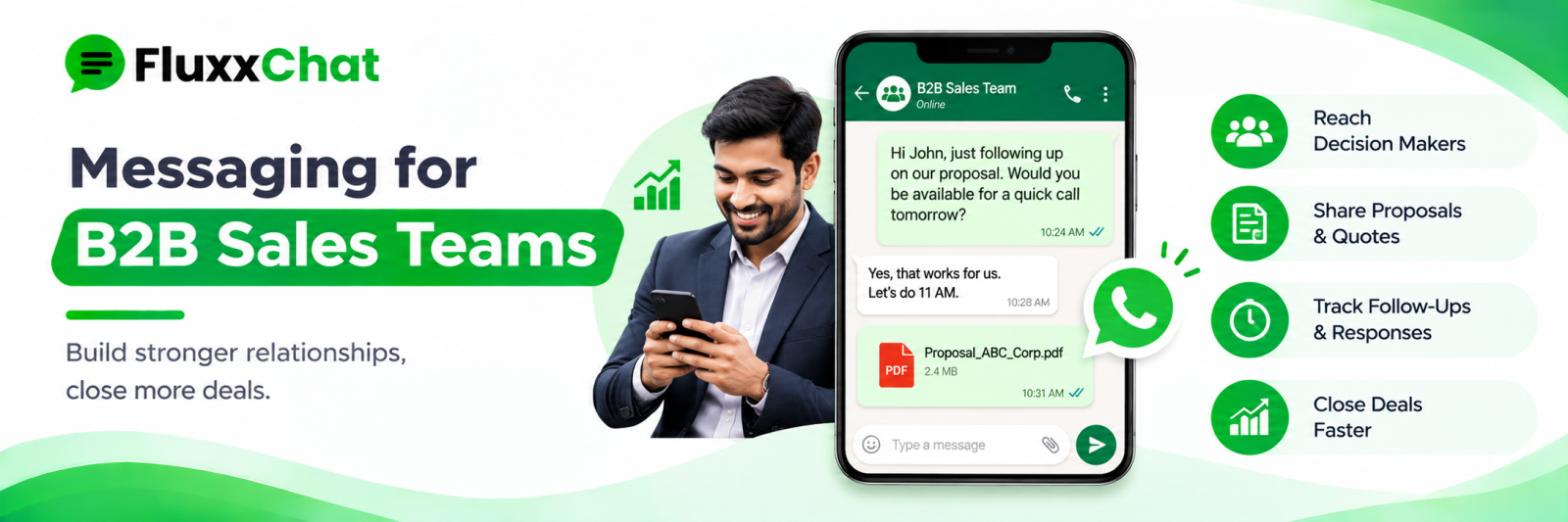
B2B selling in India runs on WhatsApp. Quotations are sent there, follow-ups happen there, negotiations happen there, and orders are confirmed there. Email exists for the formal record; WhatsApp is where the deal actually moves.
The problem is that almost all of it happens on salespeople’s personal phones, which means the company does not own its own customer relationships.
What is different about B2B
| B2C | B2B |
Decision makers | One | Several: user, purchaser, approver, finance |
Cycle length | Minutes to days | Weeks to months |
Value | Lower, higher volume | Higher, lower volume |
Documents | Rare | Quotations, specifications, POs, invoices |
Price | Fixed | Negotiated, often per contract |
Relationship | Transactional | Long-term, person-dependent |
Follow-up | Days | Months, with long quiet periods |
That last row is where most B2B deals are lost. The buyer says “we’ll decide next quarter”, and nobody follows up in next quarter.
Response speed still decides it
B2B buyers contact three or four suppliers. The first substantive response usually sets the agenda for the whole evaluation.
• Automated acknowledgement within seconds, with something useful in it
• A human response within the hour during working hours
• The product range or specification sheet sent immediately, not “I’ll send details tomorrow”
Thanks for your enquiry. Here’s our product range and specifications: [link] To quote accurately, could you tell me the quantity and specification you need? I’ll send a formal quotation today.
Quotation follow-up is the main discipline
Most B2B quotations are never followed up more than once. See our quotation software guide.
A workable cadence:
When | Action |
Day 0 | Quotation sent on email and WhatsApp |
Day 2 | “Did the quotation reach you? Any questions on the specification?” |
Day 7 | A useful input: a similar project, a technical note, a delivery update |
Day 15 | “Where has this reached internally? Anything I can help with?” |
Day 30 | Check if the requirement is still live, and when to revisit |
Then | Quarterly contact until it closes or dies |
Every quotation needs a next action with a date. A quote sitting in “sent” for three months is a lost deal nobody admitted to.
Handle multiple stakeholders
A B2B deal involves several people, often in separate chats.
• Record who is who: user, purchase, technical approver, finance, decision maker
• Know who you have not spoken to; the person you have never met is usually the one who blocks it
• Ask directly: “Who else needs to see this before you can decide?”
• Give the champion something they can forward internally: a clean PDF, a one-page summary, a comparison
• Keep every conversation against the same company account, not scattered across individual chats
A shared inbox with one account record per company, linking all contacts, is what makes this possible. Separate chats on separate phones make it impossible.
Documents belong in the thread and in the system
• Quotations as PDFs, named properly: Quotation-ABCIndustries-12Nov-Rev2.pdf
• Specification sheets and drawings
• Purchase orders received
• Invoices and delivery documents
• Test certificates, compliance documents
Version numbers in the filename prevent the classic B2B failure: delivering against revision 1 while the customer expects revision 3.
Store them against the account record, not only in the chat. See our contract management guide.
Account continuity: the real risk
When a salesperson leaves, the relationships should stay with the company. On personal phones, they do not.
What to put in place:
• A business number, not personal numbers, for customer contact
• A shared inbox where every conversation is visible to the company
• Account ownership recorded, with a backup owner
• Contact details stored in the system, not in one person’s phone contacts
• A handover process: accounts reassigned, the customer informed personally
• Access removed on exit, the same day
This is uncomfortable to introduce and worth doing anyway. The alternative is paying to rebuild relationships you already own.
Keep WhatsApp and the CRM in step
The common failure: the deal progresses on WhatsApp and the CRM is updated once a month from memory, badly.
• Log the conversation against the account automatically where possible
• Mandatory fields: stage, value, next action, next action date
• A weekly pipeline review from the system, not from recollection
• No deal without a next action
If updating the CRM is harder than the conversation, it will not happen. Connect the two. See our API integration guide.
Tone
B2B messaging is more formal than consumer chat, but not stiff:
• Full sentences, correct spelling
• Minimal emoji; one is fine, five is not
• No voice notes unless the customer uses them
• Working hours, mostly; a message at 10 pm reads as desperate
• Address people properly
• Confirm verbal agreements in writing, politely: “Just to confirm what we discussed…”
That last habit is the most valuable. Every commercial agreement reached by phone should be summarised in a message immediately afterwards.
What to automate, and what not to
Stage | Automate? |
Enquiry acknowledgement | Yes |
Sending the product range or catalogue | Yes |
Qualifying question | Yes |
Quotation reminder to the salesperson | Yes |
Order status and dispatch updates | Yes |
Payment reminders | Yes |
Follow-up messages to the customer | Mostly human; a templated chase reads badly in B2B |
Negotiation | Human |
Technical discussion | Human |
B2B buyers notice automation more than consumers do, and tolerate it less in the middle of a deal. Use it at the edges: acknowledgement, documents, logistics and reminders.
Measure
Metric | Why |
Response time to new enquiries | The main early differentiator |
Quotations sent per week | Activity |
Quotations with a next action set | Discipline |
Quotation-to-order rate | Pricing and follow-up quality |
Average sales cycle length | Forecasting |
Deals lost with no follow-up recorded | The leak |
Revenue per account over time | Account development |
Accounts with only one contact person | Relationship risk |
Those last two rows are the B2B-specific ones. A growing account with a single contact is one resignation away from being lost.
Frequently asked questions
Is WhatsApp appropriate for B2B in India? Yes, and increasingly expected. Keep the formal record on email and the momentum on WhatsApp.
Should salespeople use their own numbers? No. The company should own the number and the conversation history.
How many follow-ups is too many in B2B? Far more than in B2C. Persistent, useful, spaced contact over months is normal and expected.
Ready to automate WhatsApp and Instagram?
Start with FluxxChat: campaigns, chatbot and a shared inbox for your team.
Get started free