In this article
A message that arrives on the right day, for the right reason, is read. Most marketing messages are not.
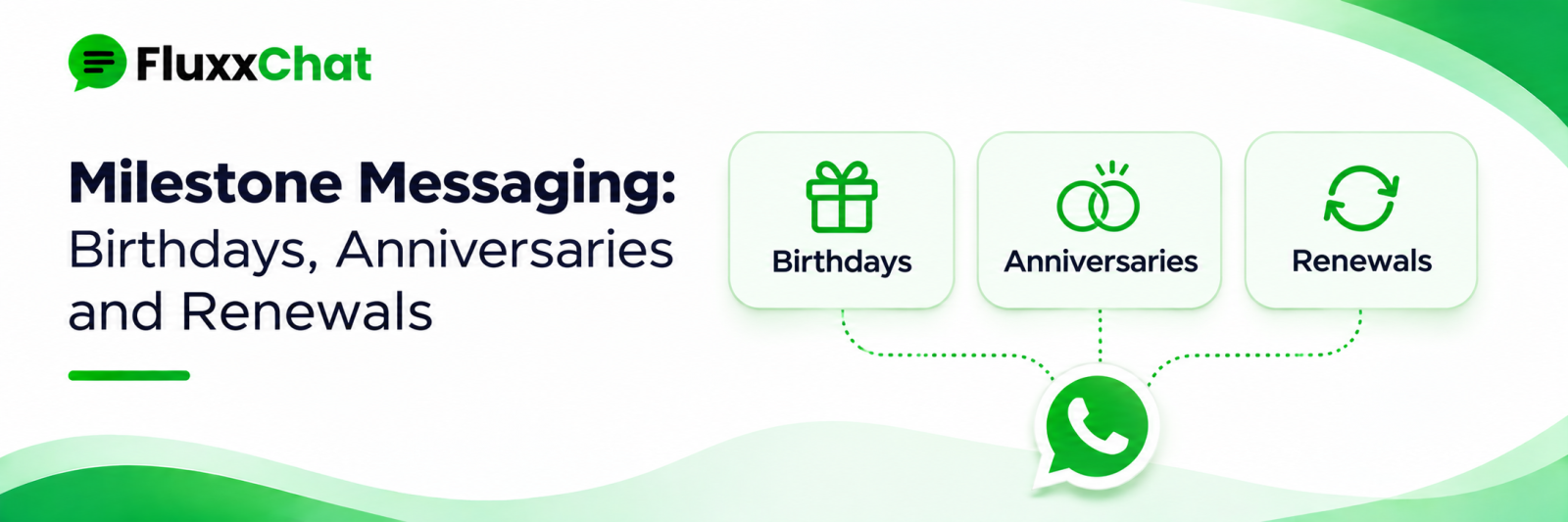
Milestone messaging uses dates you already know — or could easily collect — to send something relevant instead of another blast. It works because the timing does the work.
Milestones worth using
Milestone | Who it suits | What to send |
Birthday | Retail, restaurants, salons, clinics | A genuine offer, valid for a week |
Wedding anniversary | Jewellery, restaurants, travel, photography | Gift ideas or a celebration offer |
Purchase anniversary | Any product business | Service reminder or a loyalty gesture |
Service due | Vehicles, appliances, AMC, dental | Reminder with booking link |
Membership renewal | Gyms, clubs, software, subscriptions | Value summary plus renewal |
Warranty expiry | Electronics, appliances, vehicles | Extended warranty or a check-up |
Insurance renewal | Vehicles, health, where you are the intermediary | Renewal reminder |
First purchase anniversary | Any business | Thank you, with a small gesture |
Child’s milestone | Education, paediatric clinics, photography | Age-appropriate offer |
Festival | Everyone | Relevant, not generic |
The strongest performers are the ones tied to something the customer actually needs: service due, renewal, warranty expiry. These are useful, not promotional, and they convert far better than a birthday discount.
Collect the dates without being creepy
• Ask at the point of sale, naturally: “Shall I note your birthday? We send a small offer”
• A short form after the first purchase
• During onboarding for a membership
• Purchase date is automatic; you already have it
• Service and renewal dates come from your own records
Ask for the day and month only. Collecting a full date of birth invites questions about why you need it, and it is more personal data than the purpose requires.
Make it clearly optional, and say what you will send.
Messages that do not feel automated
Weak:
Happy Birthday! Get 20% off at [Business]. Visit us today!
Better:
Happy birthday, [Name] 🎉 Hope you have a good one. If you’re celebrating with family, your table’s on us for the dessert — just mention this message, valid till [date].
The difference: the greeting comes first and means something, the offer is specific and small, and it has an end date.
Service due:
Hi [Name], your [vehicle/AC/water purifier] service is due around [month]. Last service was on [date] at [reading]. Want me to book a slot this week? Takes about [duration].
Purchase anniversary:
Hi [Name], it’s been a year since you bought the [product] from us 😊 Hope it’s working well. If it needs a check-up or you have any questions, just reply here.
That last one has no offer at all, and it generates more replies than most offers do.
Offer design
• Small and genuine beats large and conditional
• Short validity: a week for a birthday, which creates a reason to act
• No minimum purchase on a birthday gesture, if you can afford it
• Something that costs you little and feels good: a free add-on, a dessert, an upgrade, a free service
• Never the same discount you publicly advertise to everyone; that makes the “special” offer insulting
Rules and frequency
Business-initiated messages on WhatsApp need opt-in and approved templates, and marketing messages are charged and treated more strictly than utility ones. A service-due reminder and a birthday promotion are not the same category.
Check Meta’s current WhatsApp Business Platform rules before building these flows. See our templates guide.
Frequency discipline:
• No more than one milestone message per customer per month
• Suppress milestone messages if you have sent a campaign in the last few days
• Never send a birthday offer to someone with an unresolved complaint open
• Honour opt-outs immediately and permanently
• Stop all of it if the customer asks
A customer receiving a cheerful birthday discount while waiting for a refund will post about it.
Suppression rules matter
Build these in before launching:
Situation | Action |
Open complaint | Suppress all marketing |
Recently opted out | Suppress permanently |
Received a campaign in the last [X] days | Delay or skip |
Bereavement or difficult circumstance known | Suppress; handle manually |
Customer marked inactive or lost | Review before sending |
Duplicate contact records | Deduplicate, or they receive it twice |
Duplicates are the most common embarrassment: the same customer getting the same birthday message three times because they exist three times in your contact list.
Get the data right
• Deduplicate contacts before you start
• Validate dates; a birthday stored as 01/01 for everyone means the data was never real
• Use the customer’s actual name, correctly spelt, or use no name at all rather than “Dear Customer”
• Check the name field does not contain junk: “Ravi - Saibaba Colony - 2BHK” in a name field produces an embarrassing greeting
Test on your own team’s numbers before sending to customers. Every personalisation failure is visible.
Festivals: be careful
Generic festival greetings from businesses are so common they are invisible, and a poorly chosen one can offend.
• Send to customers who celebrate it, where you know; do not assume from a name
• Make it useful, not just a graphic
• Fewer, better: Pongal and Diwali done well beats twelve generic greetings
• A greeting with no offer is fine, and often better received
See our festival campaigns guide.
Measure
Metric | Why |
Delivery and read rate | Reach |
Reply rate | Whether it felt personal |
Redemption rate | Offer quality |
Revenue per milestone type | Which ones are worth running |
Opt-outs per campaign type | Whether you are over-messaging |
Service-due conversion | Usually the highest-value milestone |
Compare milestone messages against your general broadcasts. They almost always perform better per message sent, which is the argument for sending fewer, better-timed messages overall.
Frequently asked questions
Is a birthday discount worth it? For retail, food and services, usually yes, if it is small and genuine. For B2B it often is not; a service or renewal reminder works better.
Do we need opt-in for these? For business-initiated marketing messages, yes. Utility messages such as service reminders are treated differently; confirm current rules.
What if we do not have birthdays? Start with purchase anniversary, service due and renewal dates. You already have those, and they convert better anyway.
Ready to automate WhatsApp and Instagram?
Start with FluxxChat: campaigns, chatbot and a shared inbox for your team.
Get started free