In this article
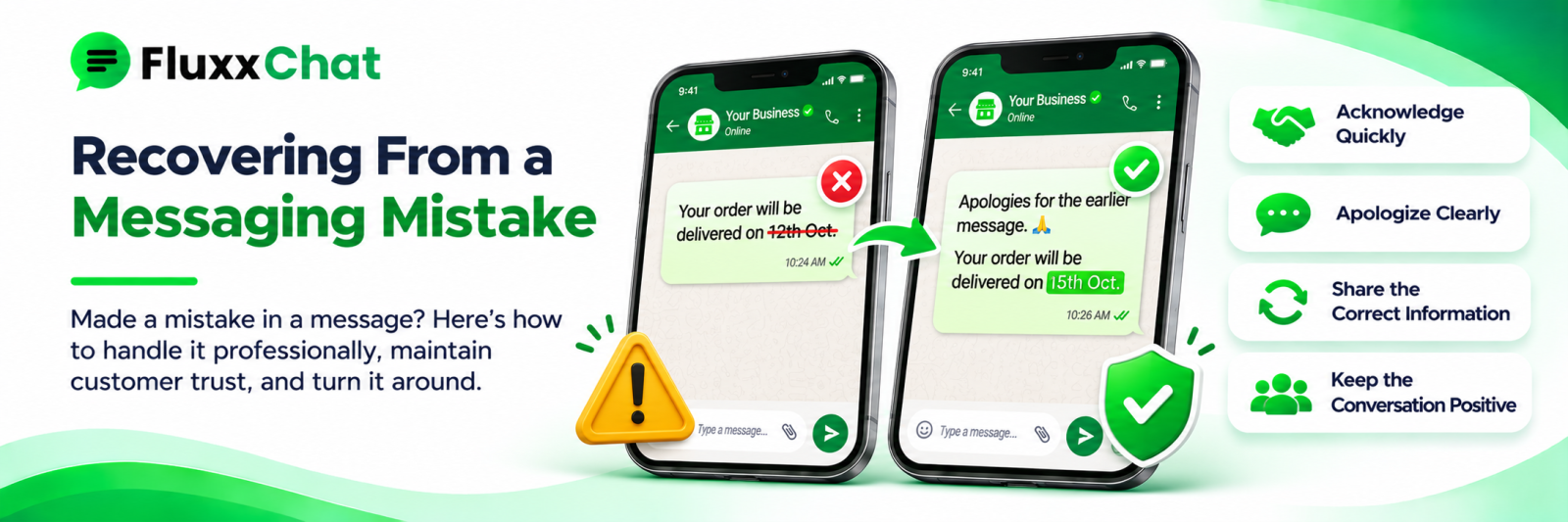
Sooner or later someone sends the wrong price to a customer, a broadcast goes out with a mistake in it, a reply meant for a colleague lands in a customer’s chat, or a campaign sends to people who opted out.
How the business handles the next hour decides whether it stays a small embarrassment or becomes a complaint, a refund, or a data problem.
First, classify it
The response depends entirely on what kind of mistake it is.
Type | Severity | Core risk |
Typo or wrong wording | Low | Looks careless |
Wrong price sent to one customer | Medium | You may have to honour it |
Wrong price in a bulk send | High | Many customers, same expectation |
Message sent to the wrong customer | Medium | Confusion, possible data exposure |
Another customer’s details sent to someone | High | Data breach |
Campaign sent to opted-out contacts | High | Compliance and platform risk |
Offensive or inappropriate content | Very high | Reputation |
Internal message sent to a customer | Medium | Depends entirely on content |
Anything involving another person’s personal data is in a different category from an ordinary mistake. Treat it as such.
The first hour
1. Stop the send. If a campaign is still going out, pause it immediately. Every additional message makes the problem bigger.
2. Establish the facts. Who received it, how many, what exactly did it say. Get the actual sent message, not someone’s recollection.
3. Delete where possible. WhatsApp’s delete-for-everyone works within a time window and is not guaranteed; the recipient may have already read it or have a notification preview. Delete, but do not assume it is gone.
4. Decide whether to correct publicly or individually. One recipient: correct in that chat. Many: a correction message to the same list.
5. Tell the right people internally. The owner, and for data exposure, whoever handles compliance.
The correction message
Short, clear, no excuses.
Wrong price to one customer:
Hi [Name], I’m sorry — I sent you an incorrect price. The correct price for [item] is ₹[X], not ₹[Y]. Apologies for the confusion.
Wrong information in a bulk send:
Correction: our earlier message had an error. The offer is [correct detail], valid till [date]. Sorry for the confusion.
Message sent to the wrong person:
Hi [Name], apologies — my previous message was meant for someone else. Please ignore it.
Do not over-explain. A long apology draws more attention to the mistake than a short correction.
If you quoted the wrong price
The commercial question: do you honour it?
Factors:
• How wrong was it? An obvious error is different from a plausible one
• Has the customer acted on it?
• What is the cost of honouring it against the cost of the goodwill?
• Did it go to one person or two thousand?
For one customer with a modest difference: often cheaper to honour it and move on.
For an obvious error: explain honestly and offer something: “That price was a mistake on our side — it’s ₹[X]. I can offer you [small gesture] for the inconvenience.”
For a bulk send: correct quickly, apologise, and consider honouring it for anyone who already ordered before the correction. Whatever you decide, apply the same rule to everyone; inconsistency here produces screenshots.
Take advice if the amounts are significant; a quoted price may create expectations with legal weight depending on the circumstances.
If you exposed another customer’s data
This is the one that needs real care.
1. Stop and contain — delete where possible
2. Record exactly what was exposed, to whom, and when
3. Ask the recipient to delete it, politely, in writing
4. Inform the person whose data it was, honestly
5. Assess severity — a name is different from financial details, health information or identity documents
6. Take legal advice on whether the DPDP framework requires notification, and to whom
7. Document everything, including what you did to contain it
Do not quietly hope nobody noticed. Under India’s data protection framework there are obligations around personal data breaches, and the position depends on the circumstances. Confirm with a legal adviser. This article is not legal advice.
See our data and consent guide.
If you messaged people who opted out
• Stop the campaign immediately
• Identify how the opt-out list was bypassed
• Apologise to those affected, briefly
• Re-confirm their opt-out
• Fix the suppression logic before the next send
• Monitor your quality rating and block rate
Repeated messaging of opted-out contacts risks your number’s standing on the platform, which is a far larger problem than one campaign.
If something offensive went out
• Delete immediately
• A clear, short, unqualified apology
• Do not explain or justify in the apology message
• Investigate how it happened
• Respond to anyone who raises it, individually
• Expect screenshots; respond consistently wherever it appears
Speed and plainness matter more than wording. A defensive explanation makes it worse every time.
Prevent the next one
Most messaging mistakes are process failures, not individual carelessness.
Prevention | Stops |
Test send to your own number first, always, for every campaign | The majority of bulk errors |
Two-person check on any send above [X] recipients | Price and wording errors |
Prices in approved templates, not typed by agents | Wrong price quotes |
Suppression lists applied automatically, not manually | Opted-out sends |
Customer name auto-filled from the record, not typed | Wrong-person errors |
Separate internal channel, never the customer inbox | Internal messages leaking |
Scheduled sends with a delay, so they can be cancelled | Last-minute catches |
A checklist before every campaign | Everything above |
The test send is the single highest-value habit. Send every campaign to your own number and read it as a customer would, before it goes anywhere else.
Write down what happened
After anything significant:
• What happened and when
• How many were affected
• What was done
• What it cost
• What change prevents it recurring
• Who owns that change
Three paragraphs. The point is the last two lines.
Frequently asked questions
Can we delete a WhatsApp message after sending? Delete-for-everyone works within a limited window and is not guaranteed. Assume the recipient may have seen it.
Should we apologise publicly for a bulk error? Correct it to the same audience that received it. A wider public apology usually draws more attention than the error did.
Do we have to honour a wrongly quoted price? It depends on the circumstances and the amounts. For small differences, honouring it is often cheaper than arguing. Take advice for anything significant.
Ready to automate WhatsApp and Instagram?
Start with FluxxChat: campaigns, chatbot and a shared inbox for your team.
Get started free