In this article
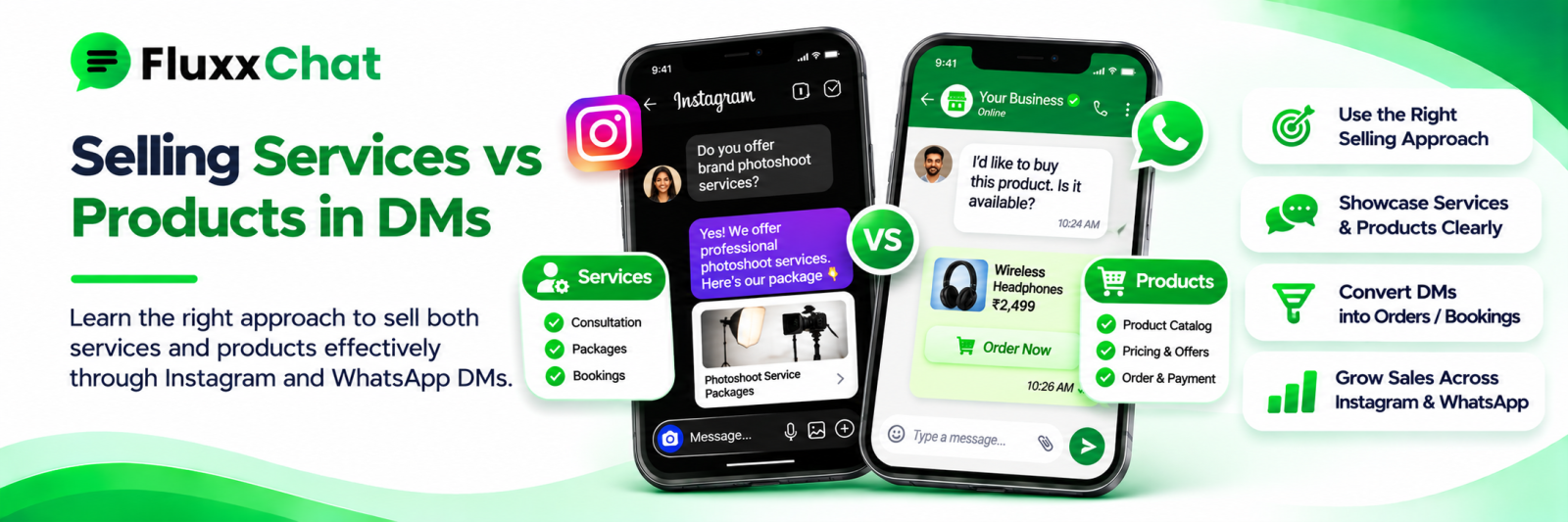
A product enquiry and a service enquiry look the same in your inbox. They need almost opposite handling.
A product buyer wants a fact: is it available, what does it cost, when will it arrive. A service buyer wants reassurance: can you actually do this, have you done it before, and what will it cost for my situation.
Treating a service enquiry like a product enquiry is why many service businesses convert badly in DMs.
The core differences
| Product | Service |
The question | “Is it available, how much?” | “Can you do this for me?” |
Price | Fixed, listable | Depends on scope |
Decision speed | Minutes to days | Days to months |
What convinces | Photos, price, reviews | Proof of similar work, the person |
Conversation length | Short | Long, multi-stage |
Automation | Can carry most of it | Carries only the opening |
Delivery | Dispatch | A relationship over time |
Risk for the buyer | Return it | Wasted time and money |
That last row explains the behaviour. A wrong ₹2,000 product is annoying. A wrong ₹2,00,000 service engagement is a disaster, so the buyer takes longer and asks more.
Scope before price
The single biggest mistake in service DMs is quoting a number before understanding the job.
Weak:
“Website is ₹25,000.”
Better:
“Websites range from ₹[X] for a straightforward business site to ₹[Y] for something with bookings or an online store. What does yours need to do — mainly show information, take enquiries, or sell online?”
Give a range so they can self-qualify, then ask the one question that determines where in the range they sit.
See our handling price questions guide.
The scoping questions
Three or four, asked conversationally, not as a form:
1. What are you trying to achieve? The outcome, not the deliverable
2. What is the current situation? What exists, what is broken
3. Timeline — when do they need it
4. Budget range — asked carefully, framed as helping you propose the right option
For budget:
“Do you have a rough budget in mind? It just helps me suggest the right option rather than something that doesn’t fit.”
Framed that way, most people answer. Asked bluntly, many do not.
Trust is the product
A service buyer is deciding whether to believe you. Give them reasons:
• Similar work: “We did something close to this for a [industry] client in [city]”
• Process: explain how you work, which reduces perceived risk
• Names: introduce the person who will do the work
• Case studies: send a link. See our case studies guide
• Honesty about limits: “We don’t do [X]; for that you’d want a specialist”
That last one converts better than claiming to do everything. Saying no to one thing makes your yes credible.
Move to a call, or a proposal
Services rarely close in chat. The DM’s job is to earn the next step.
• For smaller services: a written quotation in chat may be enough
• For larger ones: a call or a meeting, then a proposal
• Make the next step easy and specific: “Are you free for a 15-minute call tomorrow at 11 or 4?”
Offering two slots converts better than “when are you free?”.
Proposals
• Restate their requirement in their words, which proves you listened
• Scope: what is included and what is not
• Approach and timeline
• Price, with options where sensible
• What you need from them
• Validity date
The exclusions section prevents most later disputes. See our quotation software guide.
Follow-up is longer and gentler
Product follow-up is days. Service follow-up is weeks or months, and pressure does not work.
When | Approach |
Day 2 | “Did the proposal reach you? Any questions on the scope?” |
Day 7 | Something useful: a relevant example, an article, an observation about their situation |
Day 15 | “Where has this reached at your end? Anything I can help clarify?” |
Day 30 | Check whether it is still live and when to revisit |
Quarterly | Stay in touch until it closes or dies |
Send useful things, not reminders. A service buyer who receives something genuinely helpful during their decision remembers who sent it.
What to automate
Stage | Automate? |
Acknowledgement | Yes |
Service list and price ranges | Yes |
First scoping question | Yes |
Sending case studies or a portfolio link | Yes |
Booking a call | Yes, with a link |
Scoping conversation | Human |
Proposal | Human |
Follow-up | Mostly human; automate the internal reminder |
Negotiation | Human |
Automation gets the enquiry answered instantly and gathers the first detail. Everything after is a person, because the buyer is evaluating the person as much as the service.
If you sell both
Many businesses sell products and services: a furniture shop that also does interiors, a boutique that also does custom tailoring.
• Separate keyword routes for each
• Different reply templates
• Different people, where possible
• Separate pipelines and reporting
A single generic reply serves neither well.
Measure
Metric | Why |
Enquiry to scoping-conversation rate | Whether your opening works |
Scoping to proposal rate | Qualification |
Proposal to win rate | Pricing and positioning |
Average days from enquiry to decision | Realistic forecasting |
Loss reasons | Price, timing, scope, competitor |
Proposals with no follow-up recorded | The leak |
Service businesses should measure time to decision honestly. Expecting a two-day close on a three-month decision leads to giving up on deals that were still alive.
Frequently asked questions
Should service businesses publish prices? Publish ranges and what drives them. It filters mismatched enquiries and saves everyone time.
Can a bot handle service enquiries? Only the opening. Scoping and trust-building need a person.
How long should we keep following up? Until they buy, say no, or the requirement dies. For large services, that can be a year, with useful contact every few weeks.
Ready to automate WhatsApp and Instagram?
Start with FluxxChat: campaigns, chatbot and a shared inbox for your team.
Get started free