In this article
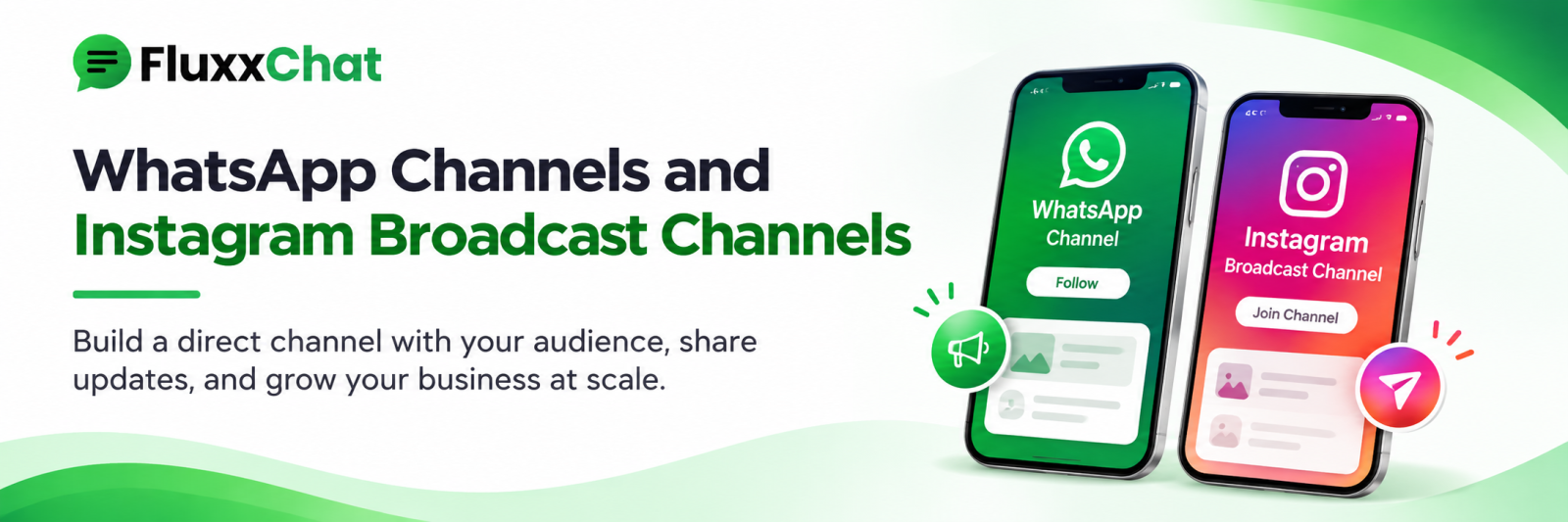
Channels are a one-way format: you post, followers read, nobody replies in public. Both WhatsApp and Instagram offer them, and they sit between a social feed and a direct message.
For businesses they solve a specific problem: reaching people who want updates, without the cost of per-message broadcasts or the chaos of a group.
Meta changes channel features, availability and limits regularly. Check Meta’s current documentation before planning around any specific behaviour.
How channels differ from what you already use
| WhatsApp group | Broadcast list / API broadcast | Channel |
Direction | Everyone talks | You send, they reply privately | You post, no public replies |
Member limit | Limited | Limited by your contact list | Very large |
Who can join | You add them | People who saved your number | Anyone with the link |
Privacy | Members see each other’s numbers | Private | Followers’ identities not shown to each other |
Cost | Free | Charged per message on the API | No per-message charge of that kind |
Discovery | None | None | Searchable, shareable link |
Best for | Small communities | Targeted, transactional messaging | Announcements to a wide audience |
The privacy point matters commercially: in a group, every customer can see every other customer’s number, which is both a nuisance and a data problem. Channels avoid that.
When a channel beats a broadcast
Use a channel for:
• New arrivals and restocks
• Offers and sale announcements
• Event and class schedules
• Daily rates, where your business publishes them
• Menu of the day
• Content updates: new videos, articles, podcasts
• General announcements to anyone interested
Use targeted messaging for:
• Order confirmations and delivery updates
• Appointment reminders
• Payment dues
• Anything personal to one customer
• Anything where you need a reply
Channels are publishing. Messaging is conversation. Mixing them annoys people.
The cost argument
Business-initiated WhatsApp messages are charged by category, and a marketing broadcast to 5,000 people costs real money every time you send it. A channel post to 5,000 followers does not carry that same per-message charge.
For a business that wants to announce offers frequently to a large audience, that difference is substantial. The trade-off is reach certainty: a broadcast lands in the chat list; a channel post sits in the updates area, which people check less often.
A practical split many businesses settle on: channel for frequent announcements, paid broadcast for the few messages that must be seen.
Setting up well
• Name: your business name, exactly as customers know it
• Description: what you will post, and how often. “New arrivals and offers, 2–3 times a week” sets expectations and reduces unfollows
• Photo: your logo
• Link: share it everywhere — website, Instagram bio, WhatsApp auto-reply, bills, QR at the counter
• Verification: where available and applicable to your business
Growing followers
Channels have no built-in audience; you bring one.
• Put the link in your Instagram bio and story highlights
• Add it to your WhatsApp auto-reply: “Follow our channel for offers: [link]”
• QR code at the counter and on bills
• Mention it in your email signature
• Tell existing customers during a conversation
• A joining incentive, used once: early access, a small discount
• Cross-promote between your WhatsApp and Instagram channels
What to post, and how often
Frequency | Outcome |
Daily | Only if you genuinely have daily content: rates, menu, availability |
2–3 times a week | Comfortable for most retail and service businesses |
Weekly | Fine for lower-frequency businesses |
Monthly | Too infrequent; people forget who you are |
Content that works:
• Photographs of actual new stock, not graphics
• Short videos
• Price and availability
• A clear next step: “Reply to our WhatsApp number to order”
Since followers cannot reply in the channel, every post needs a route to a conversation: a WhatsApp link, a phone number, a website link. Without it you are broadcasting into a void.
Measure
Metric | What it tells you |
Follower count and growth | Audience size |
Views per post | How many actually see it |
Views as a share of followers | Whether people still check |
Reactions | Rough engagement signal |
Link clicks or messages generated | Commercial result |
Unfollows after a post | You over-posted, or posted badly |
Watch views as a percentage of followers over time. A falling percentage means your posts have become ignorable.
Common mistakes
• Treating it as a group and expecting conversation
• Posting only offers, so people mute it
• Posting several times a day
• No way to act on a post
• Starting a channel and abandoning it after three weeks
• Importing nothing: expecting followers to appear without promotion
Frequently asked questions
Can followers message me from a channel? Not inside the channel. Include a link to your WhatsApp number so interested people can start a conversation.
Does a channel replace WhatsApp broadcasts? For general announcements, largely. For order updates and anything personal, no.
How many followers should I expect? It depends entirely on how hard you promote the link. Treat it as a list you have to build, not an audience you are given.
Ready to automate WhatsApp and Instagram?
Start with FluxxChat: campaigns, chatbot and a shared inbox for your team.
Get started free