In this article
- What a bot is genuinely good at
- What a bot should never attempt
- The structure that works
- Writing the first message
- The escape hatch
- Handling what the bot does not understand
- The handover itself
- Out of hours
- Building flows from what people actually ask
- Measuring whether it works
- Common mistakes
- Frequently asked questions
Every business that sets up a WhatsApp chatbot eventually hits the same complaint: “your bot is useless, I just want to talk to someone.”
Usually the bot is not the problem. The problem is that it was asked to do a job it cannot do, and there was no clean way out.
A chatbot done well is invisible — the customer gets an instant answer, or gets to a person quickly, and never thinks about which was which.
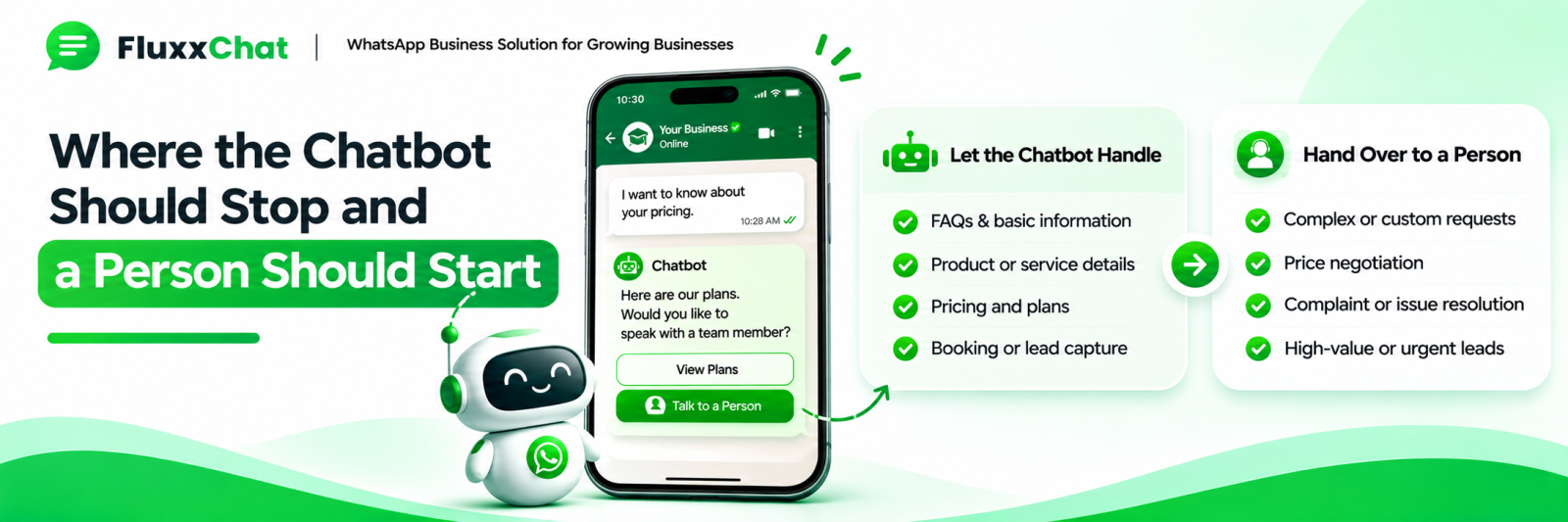
What a bot is genuinely good at
Task | Why it works |
Replying instantly, at any hour | Speed is the one thing automation always wins on |
Answering fixed facts | Hours, address, directions, parking, holidays |
Asking qualifying questions | What do you need, which product, which area |
Collecting details | Name, requirement, preferred time |
Sending documents | Price list, menu, catalogue, brochure |
Routing to the right person | Sales, support, accounts |
Status lookups | Order status, delivery tracking, appointment time |
Acknowledging out of hours | Setting an expectation instead of silence |
The pattern: anything with one correct answer that does not change.
What a bot should never attempt
Task | Why it fails |
Negotiating price | Every situation is different; a bot cannot judge |
Handling a complaint | An upset customer wants a person, immediately |
Anything about a person’s health, money or child | Too sensitive to automate |
Explaining why something went wrong | Needs judgement and accountability |
Making exceptions | A bot cannot decide to bend a rule |
Closing a significant sale | People buy from people |
Anything it has already failed at twice | Escalate instead of looping |
The pattern: anything requiring judgement, authority or empathy.
The structure that works
Think of it as three layers.
Layer 1 — Instant acknowledgement. Every message gets a reply within seconds, whatever time it arrives. This alone changes how the business feels to a customer.
Layer 2 — Routing and information. A short set of options. Give the facts if they are asked for; collect details and route if they are not.
Layer 3 — A person. For anything else, and always available on request.
The mistake is making layer 2 too deep. A bot with nine menu levels is a bot that people abandon.
Writing the first message
This sets the tone for everything that follows.
Poor
Welcome to our automated assistant. Please select from the following options to proceed. Press 1 for Sales, 2 for Support, 3 for Accounts, 4 for Careers, 5 for Other.
Better
Hi! Thanks for messaging Fluxx Tech.
What can I help with?
1️⃣ New project enquiry 2️⃣ Existing project 3️⃣ Something else
Or just type your question and I will pass it to the team.
What the second one does: it is short, it is in plain language, the options match what people actually want, and the last line means nobody is trapped.
The escape hatch
Every flow, at every point, must have a way to reach a person.
State it clearly and early:
Type AGENT at any time to speak to someone from the team.
And make it work from anywhere — mid-flow, after a failed answer, in response to anything the bot did not understand.
A bot that loops “Sorry, I did not understand that” three times with no exit is the single most reliable way to lose a customer who was ready to buy.
Handling what the bot does not understand
The first failure should not be a dead end.
First time
Sorry, I did not quite get that. Could you rephrase it, or type AGENT and someone from the team will help?
Second time — escalate, do not ask again
Let me get someone to help with this. Our team is available 9.30am to 6.30pm and will reply shortly. If it is urgent, call 88073 27953.
Two attempts, then a person. Not five.
The handover itself
This is where most setups fail, and the failure is always the same: the customer is asked to repeat everything they just typed.
What the person taking over must see
• Everything the customer said
• Everything the bot collected — name, requirement, product, area
• Which route they came through
• Any previous conversations with this customer
• Any internal notes from before
With a shared inbox this is automatic — the person opens the conversation and the whole history is there.
What the handover message should say
Thanks for the details. Priya from our team will reply in a few minutes.
Then Priya opens with something that proves she read it:
Hi Suresh, Priya here. I see you are looking at the 2 BHK in Saravanampatti — let me check availability and come back to you.
Not: “Hello, how may I help you?”
That one difference is what separates a setup customers like from one they complain about.
Out of hours
The bot’s most valuable job.
Thanks for messaging. Our team works 9.30am to 6.30pm, Monday to Saturday. We have your message and will reply first thing tomorrow.
In the meantime, is there anything I can help with?
1️⃣ Pricing information 2️⃣ Location and timings 3️⃣ Leave your details for a call back
This does three things: sets expectation, keeps the 24-hour window open, and captures the requirement so the morning starts with something useful.
Building flows from what people actually ask
Do not design flows from imagination. Read your last 200 conversations and count.
You will usually find that five or six questions make up most of the volume. Build for those. Everything else goes to a person.
Business | The questions that dominate |
Clinic | Timings, which doctor, consultation fee, appointment, location |
Restaurant | Menu, delivery, table booking, timings, parking |
Boutique | Price, size, colours available, delivery, exchange policy |
Service centre | Charges, how long, pick-up available, warranty, location |
Coaching centre | Batch timings, fee, demo class, faculty, location |
Then review quarterly. The questions change as the business changes.
Measuring whether it works
Metric | What it tells you |
Conversations fully handled by the bot | How much work it is actually saving |
Escalations to a person | Normal and healthy; a very low number may mean customers are stuck |
“AGENT” requests in the first message | Customers do not trust the bot — review the opening |
Drop-offs mid-flow | Your flow is too long |
Repeated “did not understand” | Missing answers you should add |
Response time after handover | The bot was fast; is the team? |
A warning about the first metric. A high bot-resolution rate is only good if customers were actually helped. A bot that answers nothing and nobody can escape from also shows a high resolution rate, because people give up rather than escalate. Read some conversations, not just the dashboard.
Common mistakes
Mistake | Effect |
Menus more than two levels deep | People abandon |
No way to reach a person | Complaints, blocks |
Bot pretending to be human | Feels deceptive when discovered |
Person re-asking what the bot collected | The most annoying thing you can do |
Bot handling complaints | Makes an upset customer angrier |
Never reviewing the flows | Answers go stale |
Automating because it is possible | Solving a problem you do not have |
Frequently asked questions
Should the bot say it is a bot? It should not pretend to be a named person. A friendly, neutral tone is fine. What matters is that the route to a human is obvious.
How long should a flow be? Three to four steps to an answer or a handover. Beyond that, people leave.
Can the bot work in Tamil and English? Yes. Offering a language choice as the first step works well and costs one extra step.
What if nobody is available when the bot escalates? Say so honestly, give the hours, and capture the requirement. Silence is worse than a clear “tomorrow morning”.
Does a bot reduce the number of staff I need? It reduces repetitive work, which lets the same people handle more conversations well. It does not replace the people who close sales and solve problems.
How often should flows be reviewed? Monthly for the first three months, then quarterly. Read actual conversations, not just the metrics.
Ready to automate WhatsApp and Instagram?
Start with FluxxChat: campaigns, chatbot and a shared inbox for your team.
Get started free