In this article
Admission season for a coaching centre is short and intense. Results come out, enquiries arrive in a rush over a few weeks, and then it goes quiet until the next cycle.
The institutes that fill their batches are rarely the ones with the best teaching on paper. They are the ones that answered first, answered clearly, and followed up.
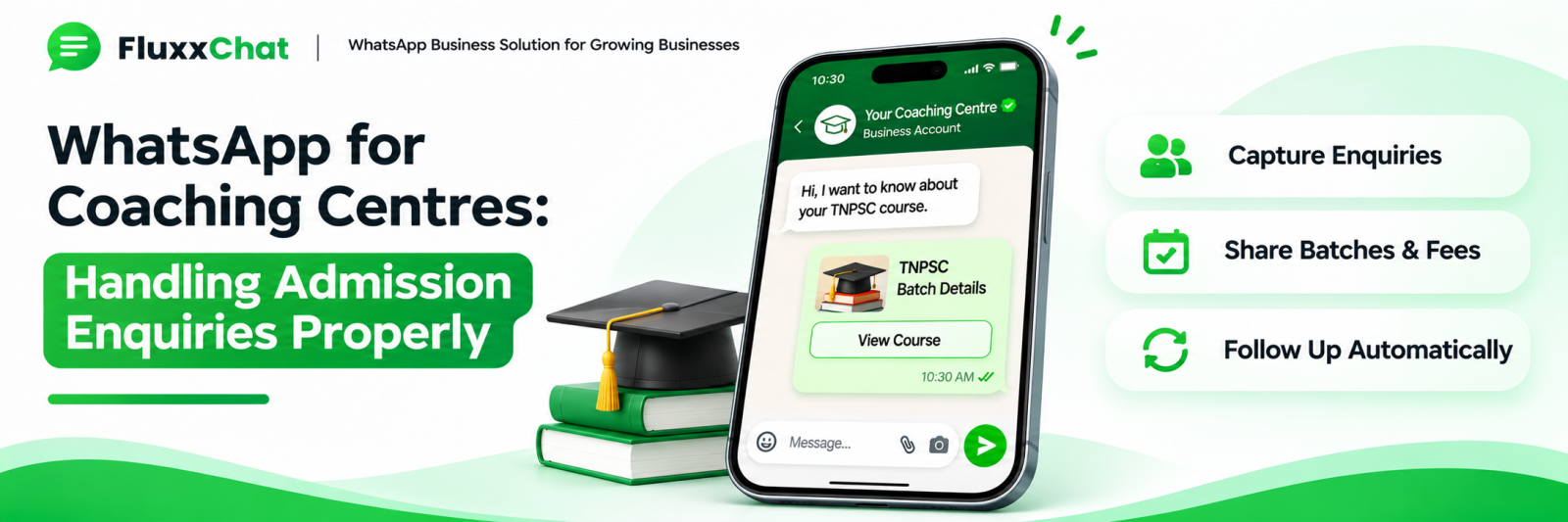
Most enquiries arrive on WhatsApp. Here is how to handle them so none are lost.
The problem with admission season
• Fifty enquiries arrive on a Saturday and three people are trying to answer from their own phones
• The same five questions get typed out again and again
• A parent asks about fees at 9pm and hears back on Monday
• Nobody knows which enquiries were followed up
• When the counsellor who handled someone leaves, the history goes with them
• After the season, there is no record of who enquired and did not join
All of these are solved by having one number, one inbox, and some automation.
What to automate, and what not to
Automate
• The first response, within seconds
• Qualifying questions — which class, which exam, which batch
• Standard information — batch timings, syllabus, faculty, location
• Reminders for demo classes
• Follow-up sequences for enquiries that went quiet
Do not automate
• Fee negotiation
• A worried parent’s questions about their child’s prospects
• Anything involving a student’s performance
• Complaints
The rule: automate the information, hand over the decision. A parent choosing where to send their child wants to speak to a person. The automation’s job is to answer the routine parts quickly so the counsellor’s time goes where it matters.
The first-response flow
When someone messages, a flow should run immediately.
Hi! Thanks for contacting [Institute name].
To help you properly, could you tell me which one you are looking for?
1️⃣ NEET 2️⃣ JEE 3️⃣ Class 11 & 12 Board 4️⃣ Foundation (Class 8–10) 5️⃣ Something else
Based on the answer, send the relevant batch information — timings, duration, start date, location, what is included.
Then ask one qualifying question:
Is this for the {{1}} batch starting in {{2}}? And is the student currently in which class?
Within ninety seconds, you know what they want and whether you have a batch for them. A counsellor picking this up now starts from a useful position rather than “hello, tell me what you need”.
What parents actually ask
Build your automated answers around the real questions. These are the ones that come up over and over:
Question | What your answer needs |
What are the batch timings? | Exact days and hours, and whether there is a weekend option |
What is the fee? | Your fee structure, clearly, including what is and is not included |
Is there a demo class? | When, how to book, whether it is free |
Who teaches? | Faculty names and backgrounds |
What is the batch size? | The actual number |
Where exactly are you? | Location with a map link |
Do you provide study material? | What is included |
Is there a hostel or transport? | Yes or no, with details |
What about previous results? | Only what you can genuinely substantiate |
On that last one: be careful. Publish results you can verify, and do not make claims about outcomes you cannot support. Parents increasingly check, and in an environment where every institute claims the same things, verifiable specifics stand out more than large numbers.
The fee question
Every institute handles this differently and there is no single right answer.
If your fees are published, send them immediately. It saves everyone time and filters out people for whom it is out of range.
If fees vary by batch, duration or scholarship, say so and explain the basis:
Fees depend on the batch and duration. For the two-year NEET programme it is {{1}}, and for the one-year repeater batch it is {{2}}. Scholarships are available based on the entrance test. Shall I arrange a call to go through the options?
What does not work is “please visit the centre for fee details”. Parents comparing four institutes will drop the one that will not tell them.
Follow-up that works
Most enquiries do not convert on the first conversation. Parents are comparing, discussing at home, waiting for results.
A simple sequence:
When | Message |
Day 1 | Information sent, counsellor speaks to them |
Day 2 | Demo class invitation with a specific date |
Day 4 | “Any questions after the demo? Happy to go through anything.” |
Day 7 | Batch filling update, if genuinely true |
Day 14 | Final reminder before the batch starts |
Honesty matters here. “Only 3 seats left” when there are twenty is the kind of thing that gets discussed in parent groups. Say it only when it is true.
During the course
WhatsApp earns its value after admission too.
• Class schedule changes and holiday notices
• Test dates and syllabus for each test
• Attendance alerts to parents
• Fee instalment reminders
• Study material and recorded session links
• Parent-teacher meeting invitations
Routine communication like this is utility messaging, which is cheaper than marketing, and it is genuinely useful rather than promotional. It also keeps parents feeling informed, which reduces anxious phone calls to the office.
Keeping it manageable with a team
With a shared inbox:
• All enquiries land in one place, regardless of who is free
• Each conversation is assigned to a counsellor, so nothing is orphaned
• Internal notes record what was discussed, without the parent seeing them
• A supervisor can see which enquiries have gone unanswered
• History stays with the institute when staff change
During admission season, assign enquiries by batch or by counsellor and review the unassigned queue twice a day. The enquiries that get lost are always the ones nobody owned.
Measuring the season
Record these and compare year on year:
Metric | Why |
Enquiries received, by source | Which marketing produced them |
Average first-response time | The single biggest conversion factor |
Enquiries that booked a demo | Whether the information stage works |
Demos that converted | Whether the demo and counselling work |
Enquiries by batch | Which programmes have demand |
Reasons for not joining | Fee, timing, location, chose elsewhere |
The last one needs to be asked, and most institutes never do. Three seasons of that data reshapes how you plan batches.
After the season
Do not delete the enquiries who did not join. Many of them are next year’s admissions — a Class 11 enquiry that did not convert is a Class 12 enquiry in a year’s time.
With opt-in, a small number of genuinely useful messages across the year keeps the relationship alive: exam date announcements, free workshops, result congratulations. Not weekly promotions.
Frequently asked questions
Can I message parents who enquired last year? Only with valid opt-in, and using an approved template. Keep it relevant and infrequent.
Should the automated replies be in Tamil or English? Offer both. A language choice as the first question costs one step and makes the rest of the conversation more comfortable for many parents.
How fast should we respond during admission season? Within minutes during working hours. Automation handles the first response instantly; a counsellor should follow within the hour.
Can we send attendance and test results on WhatsApp? Yes, and parents value it. Be careful with anything sensitive about an individual student — send it to the registered parent number only, and do not include student performance details in group broadcasts.
What about a WhatsApp group for each batch? Groups work for announcements but become noisy, and every parent sees every other parent’s number. Broadcasts through the API reach everyone individually and keep replies private.
How many numbers do we need? One number for admissions and one for current students and parents works well for most institutes. The Growth plan supports three numbers and ten team members, which covers a typical admission-season team.
Ready to automate WhatsApp and Instagram?
Start with FluxxChat: campaigns, chatbot and a shared inbox for your team.
Get started free